Modern LMS vs traditional platforms: What to look for in 2026


Summary
A modern LMS should make workplace learning easier to access, administer, and apply. In 2026, that means intuitive navigation, built-in content, automated workflows, personalized recommendations, and integrations that deliver learning inside existing tools. Research found that 39% of US companies planned to buy online learning technology in 2025, increasing the need for clear evaluation criteria. Traditional systems focus on storing courses and tracking compliance, while modern platforms also prioritize adoption, relevant discovery, and lower administrative effort.
Key takeaways
- According to research, 39% of US companies planned to buy online learning tools in 2025.
- A modern LMS is built for simplicity, adoption, and delivery in the flow of work.
- Traditional systems were built to manage and track training compliance.
- Your L&D team can handle everything themselves.
- If you're one of them, you've probably noticed something: every vendor calls their platform modern.
According to research, 39% of US companies planned to buy online learning tools in 2025. If you're one of them, you've probably noticed something: every vendor calls their platform modern. But most aren’t.
This guide defines what a modern LMS actually means in 2026, how it differs from traditional platforms, and what features matter most when evaluating your next learning solution.
What is a modern LMS?
A modern LMS is built for simplicity, adoption, and delivery in the flow of work. It includes curated content libraries, requires minimal admin overhead, and integrates directly into the systems employees already use daily.
Why have traditional LMS become outdated?
Even as the LMS market has grown dramatically (expected to reach $70.83 billion by 2030, with the online learning market expanding over 900% since 2000), many platforms added features without rethinking the user experience.
The result is platforms that look pretty capable on a demo and frustrate everyone on day one:
- Admin interfaces complex enough to require IT support
- Rigid structures that prevent personalization
- Separate logins that create barriers
- Learning that’s disconnected from where work actually happens, so employees simply don't do it
That’s why organizations evaluating the best LMS for employee training now look for platforms that eliminate these obstacles from the start, not systems that require workarounds to be usable.
How is a modern LMS different from a traditional LMS?
Traditional systems were built to manage and track training compliance. Modern systems are built to drive adoption and skill development:
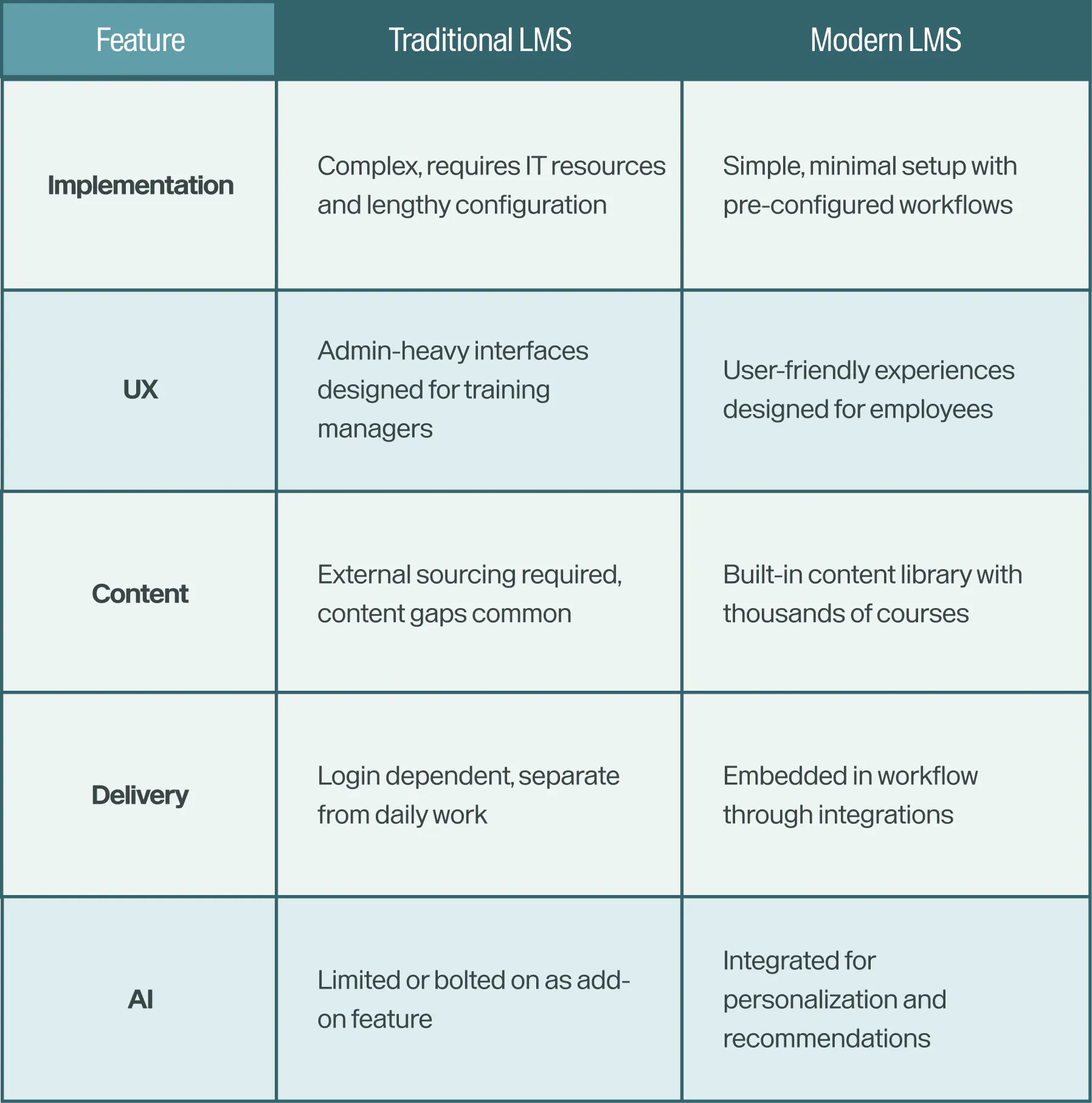
The best LMS platforms in 2026 are modern ones. They’re built for adoption, not constant administration.
What features should a modern LMS have in 2026?
A modern LMS in 2026 must include an intuitive interface, automation that eliminates manual work, a built-in content library, AI-powered personalization, manager enablement tools, and integrations that embed learning into existing workflows.
Intuitive UI
Modern LMS platforms are designed for employees first, administrators second: no training manual, onboarding sessions, and help desk tickets needed. If your L&D team needs a certification to configure it, that's a product problem.
Go1 prioritizes simplicity over complexity. Employees get access to learning that’s embedded in everyday work tools, not separate portals that require new passwords and navigation patterns.
Automation
Manual course assignments. Enrollment tracking. Reminder emails. Report generation. None of that is strategy. And yet it's where most L&D time goes.
Modern LMS platforms handle these repetitive tasks with:
- Automatic learning recommendations based on role changes and skill assessments
- Scheduled reminders without manual intervention
- Report generation on defined schedules
- Learning path updates as content libraries evolve
Built-in content library
Traditional LMS platforms function as empty containers, leaving you to source, vet, license, and upload content separately. This creates content gaps, outdated materials, and licensing headaches. And it means your team spends half their time sourcing training instead of delivering it.
Modern solutions, like Go1, solve this by including comprehensive content libraries as a core feature. Powered by AI assistants that guide learning and simplify compliance, and backed by the world's largest learning ecosystem, Go1 helps organizations move beyond one-size-fits-all training and static course catalogs.
The library covers:
- Compliance training
- Technical skills development
- Leadership development
- Emerging topics like AI literacy
This approach reduces content acquisition costs while ensuring employees always have access to current, high-quality training.
AI learning delivery
Go1 research shows 57% of learners used an AI-powered learning platform in the past month, and 82% of L&D admins now leverage AI in their programs. In fact, AI-powered adaptive learning is now the second most common delivery method after in-person training,
Translation: if your LMS doesn't have AI built in, now’s the time to find one that does.
The best LMS platforms for corporate training, like Go1, use AI to:
- Recommend learning paths based on role, skills gaps, and career goals
- Surface relevant content at the moment of need
- Deliver bite-sized learning through existing systems
- Make development feel like a natural part of work
With intelligent tools embedded across the experience, organizations reduce training time and improve knowledge retention because employees get exactly what they need, exactly when they need it.
As Melody Wong from Go1's podcast explained: "We use AI ‘nudges’ to reinforce learning. For example, it might be a Slack push to say, ‘Here’s a bit of reading that adds a different dimension to what you learned about last week."
Manager enablement
Learning does not happen in isolation from performance management. Modern LMS solutions like Go1 equip managers with visibility into team development, recommended learning for skill gaps, and tools to support career conversations.
When managers can easily see what their team members are learning and recommend relevant courses, development becomes integrated with day-to-day work.
Easy integrations
Modern LMS platforms should integrate with existing systems to eliminate friction:
- HRIS platforms for automatic role-based assignments
- Collaboration tools like Slack and Microsoft Teams for learning delivery
- Performance management systems for skills tracking
Through Morgan, Go1’s intelligent agent, learning is integrated into everyday work with contextual nudges and guided discovery.
How customizable are modern LMS platforms?
Modern LMS platforms are highly customizable. But, the difference in 2026 is that customization doesn't require development resources, implementation consultants, or months of configuration. Your L&D team can handle everything themselves.
The best LMS for corporate training, like Go1 enable L&D teams to configure learning paths, automate workflows, customize branding, and build reporting dashboards, all without writing code, submitting IT tickets, or completing technical training.
Is a modern LMS better for employee training?
Yes, but the more useful question is: better at what? Completion rates are easy to hit. Actual skill development and adoption are harder, and that's where modern platforms win.
Unlike traditional LMS, modern platforms offer:
- Higher adoption through reduced friction: Modern platforms embed learning into existing workflows like Slack or Teams, eliminating logins and dedicated time blocks.
- Increased engagement with personalized experiences: AI delivers role-specific learning at the moment of need, eliminating catalog searching and making every interaction purposeful.
- Manager reinforcement integrated into workflows: Modern platforms give managers visibility into team development during one-on-ones and performance reviews to encourage learning.
- Measurable outcomes that prove ROI: Modern platforms track skill development, application, and business impact, not just completions, allowing L&D leaders to demonstrate how learning contributes to retention and productivity.
Built-in content, AI-powered delivery, and lightweight architecture. Go1 is the best LMS platform in 2026 because it addresses all the challenges that make traditional enterprise LMS adoption so hard in the first place.
The best LMS is the one your employees use
The shift to modern LMS comes down to three things:
- Simplicity that drives adoption
- Comprehensive content libraries that eliminate sourcing gaps
- AI-powered delivery that embeds learning into daily workflows
The difference between a modern LMS and a traditional one isn't the feature list. It's whether your employees actually use it.
Modern LMS FAQs

Stay Ahead in L&D
Related Articles

Compliance Training vs. Compliance Readiness: What 945 Leaders and Employees Told Us

HR compliance training for employees: The essential topics every workplace must cover in 2026

Health & safety compliance training: How to create a safe workplace environment

Ethics and compliance training: How to build an ethical, accountable workforce

Train smarter, spend less
Connect with a Go1 expert to explore the best training options for your organization—no pressure, just solutions that work.